
Sunrise Finance

LVR Calculator

Use this calculator to determine your Loan-to-Value Ratio (LVR) and understand how it impacts your borrowing potential and costs.

4.8 (1,650+ Reviews)

Updated: 18 Nov, 2024
3 mins read

LVR Calculator

What Is Loan-To-Value Ratio (LVR)?

The Loan-to-Value Ratio (LVR) is a financial term that compares the amount of the loan to the value of the property being purchased, expressed as a percentage.

Put simply, the LVR of your loan is the percentage of the property value that you’re borrowing.

Lenders use LVR to assess risk, with lower LVRs generally indicating reduced risk for lenders.

How To Calculate LVR

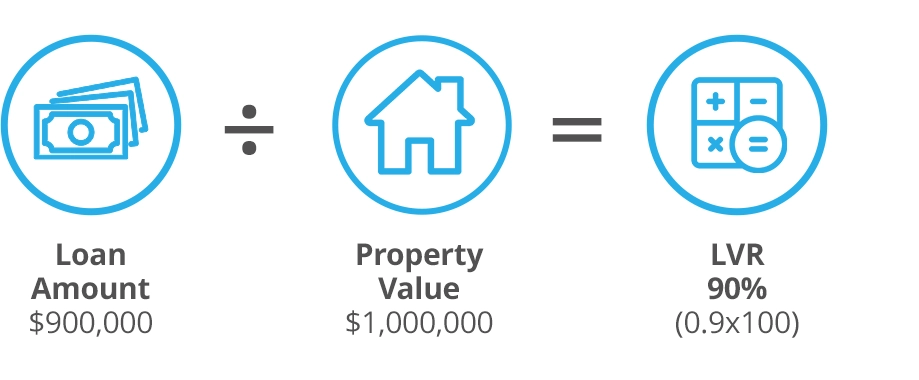
Your LVR is calculated by dividing the loan amount (the amount you’re borrowing) by the property value and then multiplying the result by 100 to express it as a percentage.

Mathematically, LVR = (Loan Amount ÷ Property Value) × 100

This formula expresses the loan amount as a percentage of the property’s value.

For example, if you borrow $900,000 against a $1 million property, your LVR is 90%.

LVR = (900,000 ÷ 1,000,000) × 100

How Does LVR Affect Your Home Loan?

The Loan-to-Value Ratio (LVR) influences various aspects of your home loan, including the interest rates you’re offered, potential additional costs like Lenders Mortgage Insurance (LMI), and your chances of securing loan approval.

Interest rates: Many lenders implement tiered pricing based on LVR brackets. For instance, an LVR below 60% may qualify for the lowest interest rates, while an LVR between 60% and 80% might incur slightly higher rates. Those with an LVR above 80% could face higher rates.
Lenders Mortgage Insurance (LMI): If your LVR exceeds 80%, lenders typically require you to pay for Lenders Mortgage Insurance (LMI) as well. This insurance protects the lender in case you default on your loan, but it is an additional cost borne by the borrower.
Loan Approval: LVR plays a crucial role in loan approval processes. Many lenders have maximum acceptable LVRs. A high LVR can reduce your borrowing power or even lead to loan rejection.

LVR Percentages And Their Implications

Each LVR percentage carries specific consequences regarding loan approval, interest rates, and additional costs such as Lenders Mortgage Insurance (LMI).

LVR Below 80%

Lenders typically don’t require Lenders Mortgage Insurance (LMI) when the LVR is under 80%, as this is considered a safer loan for the lender.
Loans with an LVR below 80% are considered lower risk and, therefore, lenders often offer more competitive interest rates.
With a lower LVR, there is a greater chance of getting loan approval, as the lender has less exposure in case of default.

LVR Between 80% and 95%

With an LVR above 80%, most lenders will require you to pay for Lenders Mortgage Insurance (LMI).
The interest rate may be slightly higher than on loans with lower LVRs.
LMI can add costs to the loan, increasing your loan repayment amount, especially if it’s capitalised.
Waived-LMI options are available.

LVR Above 95%

A guarantor loan is a good option if you need to borrow more than 95% of the property value, or even more than 100%.
You might need a deposit of more than 5% to account for additional costs of buying property, such as stamp duty and other mortgage-related and legal fees.
Lenders will likely have stringent eligibility requirements, including excellent credit scores, steady income, and a low debt-to-income ratio.

Make Informed Decisions With The 360° Home Loan Assessor

Determine how much you can contribute as a deposit.
Get clarity on the total costs of buying a home.
Explore interest-rate options based on your situation.

FAQs

How Does Property Valuation Affect My LVR

When applying for a home loan, lenders assess the property's value through their own valuation process, which may differ from the purchase price. If the bank's valuation is lower than the purchase price, your LVR will increase because you must borrow a larger proportion of the property's value.

For instance, if you intend to borrow $450,000 for a property valued at $600,000 (75% LVR) but the lender values it at only $530,000, your LVR would rise to about 85%, potentially requiring you to pay LMI.

Conversely, if the lender's valuation is higher than the purchase price, your LVR decreases, which could result in more favourable loan terms and lower interest rates, since you are borrowing a smaller percentage of the property's value.

A good Loan-To-Value Ratio (LVR) for a home loan is 60% or less, as this range allows borrowers to access lower interest rates. Most lenders will accept an LVR from 60% to 80%. Higher LVRs, above 80%, are available, but these might come with higher interest rates.

The maximum LVR for a home loan is 100%, under a guarantor home loan.

The maximum varies among lenders. Some will accept a maximum LVR of 90% to 95%, while others might cap their LVR at 80% and below.

Yes, you can avoid Lenders Mortgage Insurance through any one or a combination of the following strategies:

Save for a higher deposit so your LVR is not in LMI territory. Ideally, you want to keep your LVR below 80%.
If a family member is willing to guarantee your loan with their property, you can avoid LMI and potentially borrow up to 100% or more of the property value.
There are government schemes and programs that waive LMI for first-home buyers.
Certain professions, such as doctors, lawyers and accountants could qualify for waived LMI.
Yes, it does. When you refinance your mortgage, lenders assess your current LVR to determine the terms of your new loan. Ideally, you should owe less than 80% on your mortgage; otherwise, you will end up paying LMI again.

The benefits of a lower LVR are:

You might be able to get a lower interest rate on your loan.
You will have less LMI to pay, if any.
You will have a smaller mortgage.

Still need answers? We're here to help!

Our team of mortgage experts will assist you within 24 hours.

Relevant Areas

Calculate Your LVR

Find out your Loan-to-Value Ratio by dividing your loan amount by the property value, expressed as a percentage. This helps you understand where you stand with lenders.

Determine Borrowing Thresholds

See if your LVR meets lender requirements. Most lenders prefer an LVR of 80% or lower to avoid additional costs like Lenders Mortgage Insurance (LMI).

Plan Your Deposit Size

Understand how increasing your deposit can reduce your LVR, helping you save on costs and potentially qualify for better interest rates.

Understand LVR Impact on Costs

Learn how a high LVR affects your home loan, including higher interest rates, LMI premiums, and stricter lender conditions.

Compare Loan Scenarios

Experiment with different loan amounts and property values to see how changes in your borrowing strategy impact your LVR.

Explore LVR Waiver Opportunities

Discover programs or lender offers that may waive LVR restrictions for certain professionals or specific loan products.

Trust Sunrise Finance WA To Help You

We have thousands of five-star reviews and testimonials on Product Review, Google Review and Facebook.

4.8 out of 1,650+ reviews
4.8 out of 430+ reviews
4.8 out of 720+ reviews

What Our Customers Say About Us

Get in touch with
a specialist mortgage broker today.
With our award-winning mortgage brokers, tough home loan approvals become a breeze.